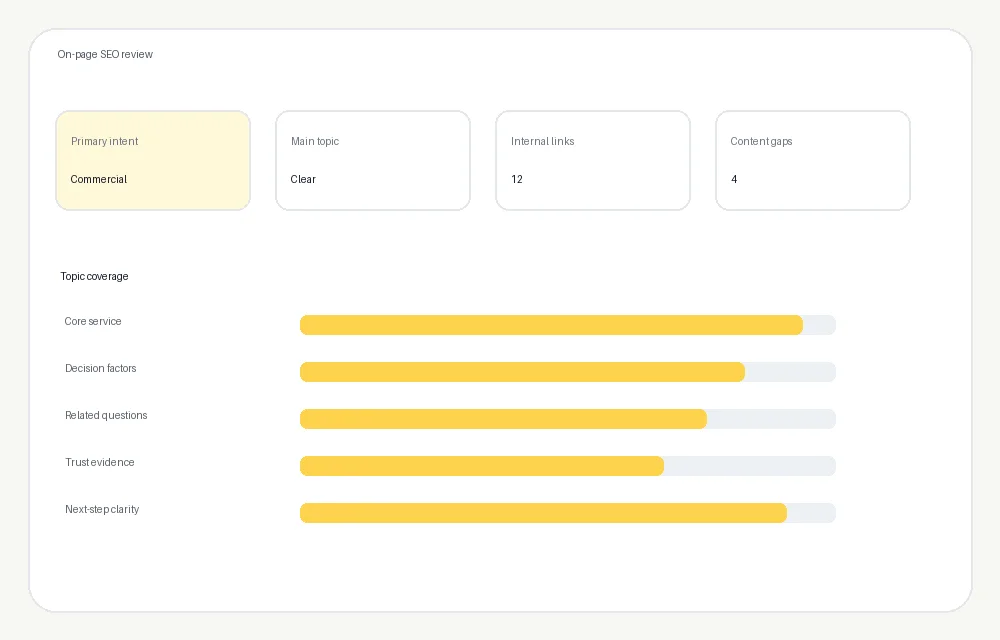
What is the searcher trying to do?
Informational, commercial, transactional and navigational needs can overlap. We identify the dominant job the page needs to perform.
On-page SEO is more than putting a keyword in the title and adding another 500 words. The page needs to match the search, cover the subject properly, connect to the rest of the site and give the visitor a useful next step.
We work on search intent, page structure, titles, headings, content, internal links, images and search-result presentation — without turning the copy into something written for a crawler.
A technically perfect page can still struggle when it answers the wrong need. Someone looking to compare services, learn a process, solve a problem or buy something expects a different kind of page.
We look at the query, the competing results and the business goal, then shape the page around the intent it actually needs to satisfy.
Informational, commercial, transactional and navigational needs can overlap. We identify the dominant job the page needs to perform.
A service page, category page, product page and guide solve different problems. We do not force a blog article into a query that clearly expects a commercial page.
We identify important subtopics, decision factors, questions and terminology that belong naturally on the page.
Ranking is only useful when the page helps the right visitor understand the offer and move to the next sensible action.
There is no useful universal number of words an SEO page needs. We focus on whether the page gives enough information for its purpose, removes obvious gaps and avoids padding the copy with repeated phrases.
That means improving what is already useful, adding missing context and cutting sections that exist only because someone thought a longer page must rank better.
Make the main subject unmistakable in the title, main heading and core copy.
Use the language, subtopics and concepts a complete explanation naturally requires — not a forced list of keyword variations.
Answer the things a visitor needs before they can compare, decide or take action.
Replace vague marketing claims with real details, examples, process, limitations or proof where the business can support them.
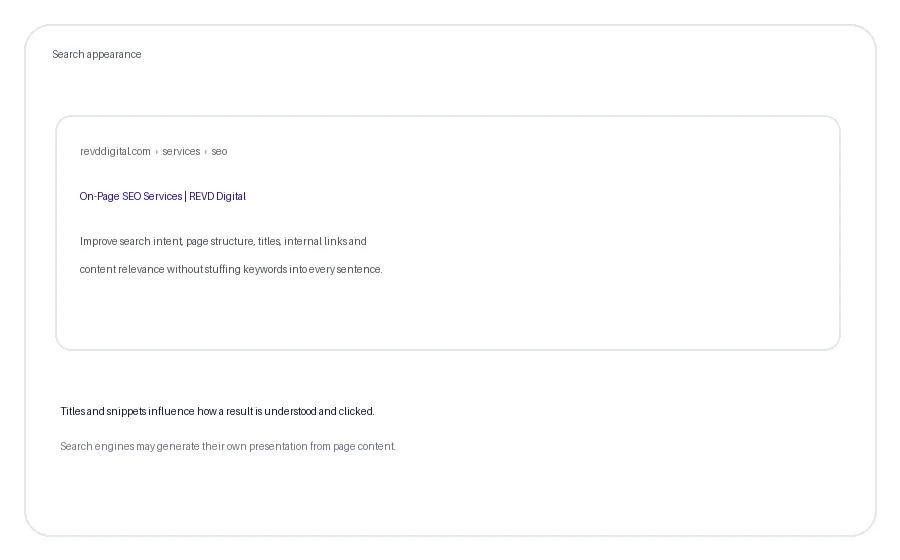
We write concise, descriptive page titles and headings that tell people what the page is about. The main query can appear naturally where it helps describe the page, but repeating it everywhere is not optimisation.
Meta descriptions are written as useful summaries and click context. Search engines may still generate a different snippet or title when another version better matches the query, so the visible page content needs to support the same message.
Internal links help visitors discover related information and help search engines understand relationships between pages. We look for orphaned or underlinked pages, weak anchors and places where a useful contextual link can clarify the site structure.
Anchor text should describe the destination naturally. We do not repeat an exact keyword in every internal link just because an SEO tool recommends it.

People search for the same problem in different ways. A strong page usually covers the main query plus the closely related concepts, comparisons, attributes and questions needed to understand that subject.
We use keyword and SERP research to find those relationships, then decide which belong on the page, which deserve their own page and which are simply different wording for the same intent.
Useful variations can be covered naturally without creating a separate near-duplicate page for every phrase.
These can become sections when they materially help the visitor understand or evaluate the main topic.
If the user needs a meaningfully different answer, format or next action, it may deserve a dedicated URL in the site hierarchy.
When several weak pages target essentially the same intent, consolidation or clearer differentiation can be better than creating another variation.
Relevant images can make a page easier to understand and can also appear in image search. We use descriptive filenames and useful alt text where an image carries meaning; decorative images can stay decorative instead of being stuffed with keywords.
Structured data can provide explicit information about eligible page content, but markup should match what users can actually see. We use supported schema where it genuinely fits rather than adding types simply because a plugin allows them.
For services, that can mean a clear process, realistic limitations, examples, case studies, responsible authorship and business information. For topics where bad advice can affect health, finances, safety or legal decisions, sourcing and expert review become much more important.
We do not add fake credentials, invented experience or unsupported claims just to make a page look more authoritative.
We map the main query, related searches, SERP patterns and the action the visitor is trying to take.
We check titles, headings, content, media, internal links, competing URLs and the page’s actual business purpose.
We rewrite, expand, consolidate or restructure where it improves usefulness and search alignment.
After search engines recrawl the page, we review how query coverage, visibility, clicks and conversions change rather than judging success by an optimisation score.
If crawling, canonicals, rendering, redirects or indexation are the real problem, see our Technical SEO services.
For the complete search strategy, including authority and off-page work, see our SEO services.
On-page SEO is the work done on individual pages to improve how well they satisfy relevant searches and how clearly people and search engines can understand them. It includes content, titles, headings, internal links, images, page structure and related contextual signals.
There is no useful universal keyword-density target. The important phrase should appear where it naturally helps describe the page, while the copy should cover the subject without repetitive keyword stuffing.
Long enough to satisfy the page’s purpose. Some searches need a concise answer or commercial page; others need detailed explanation. We do not add words simply to reach an arbitrary count.
Meta descriptions are mainly useful for describing the page in search-result snippets and encouraging the right click. Search engines may generate snippets from page content depending on the query.
No. Closely related phrases with the same intent can often be handled by one strong page. Separate URLs make more sense when the searcher needs a meaningfully different answer, service, product or page type.
It describes situations where multiple pages compete for substantially the same search need and make targeting unclear. The solution can be consolidation, differentiation, better internal linking or sometimes no change at all after reviewing the actual search data.
Both. Often the fastest opportunity is improving an existing URL that already has relevance, links or search visibility instead of replacing it with another page.
No. On-page work can improve relevance and usefulness, but rankings also depend on competition, technical accessibility, authority, search systems and other factors outside a single page.
We will look at intent, competing results, page quality, internal links and the gaps worth fixing before recommending more content.