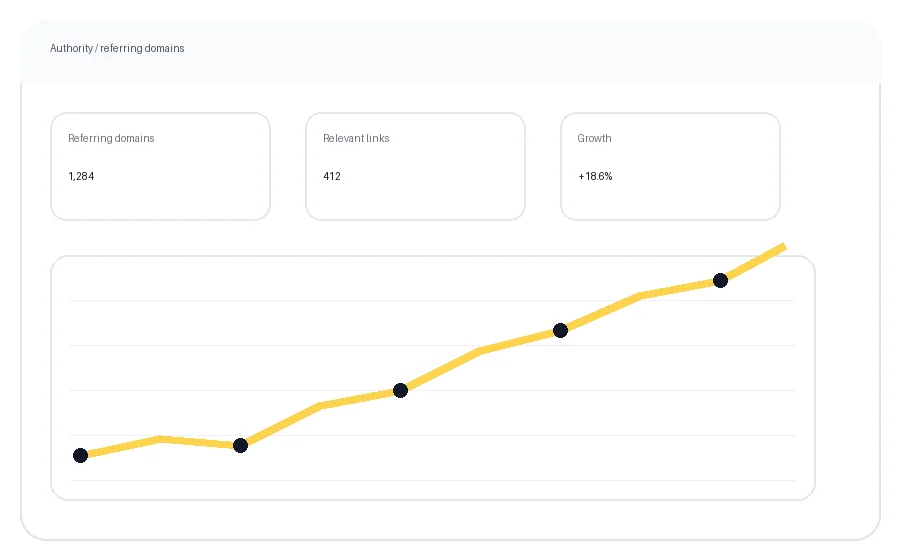
Why links still matter — and why most link building goes wrong
Google’s PageRank — the original algorithm that launched the company — was built on a simple idea: a link from one page to another is a vote of confidence. More votes from credible sources, higher rankings. That logic still holds. What’s changed is how good Google has become at detecting fake votes.
Low-quality link building — private blog networks, link farms, mass directory submissions, paid links on sites that exist purely to sell links — can still produce short-term ranking bumps. But Google catches up. And when it does, the damage is real. We’ve cleaned up after agencies that thought they were being clever. It’s not a fun conversation to have with a client.
The way around all of that is simple in principle: earn links from sites that would link to you regardless of payment, because your content or product genuinely deserves the mention. Hard to scale. Slow to build. Lasting when done right. That’s what we do.
Guest posting — editorial links from relevant publications
Guest posting is the most straightforward link building strategy that actually works at scale: you write something genuinely useful, a relevant publication publishes it, you get a link back. Simple. The execution is where it gets complicated.
We identify publications in your industry that have real readership, real editorial standards, and real domain authority. Not link mills pretending to be blogs. Actual publications your potential customers read. We pitch on your behalf, write the content (or brief your team to), and secure the placement.
Every site we target gets vetted for traffic (we check actual organic traffic, not just DR), editorial quality (is this real content or just a link repository?), relevance (does this audience overlap with yours?), and link profile health (are their outbound links clean?). If it doesn’t pass, we don’t pursue it.
Niche edits — links placed in existing ranking content
Niche edits (also called link insertions) are links placed within existing articles that already rank in Google. The article has history, authority, and traffic. Getting your link into that context means you benefit from all three.
The difference between a niche edit and a paid link is editorial intent. We reach out to site owners and editors with a genuine value proposition — usually a suggestion for a better, more relevant resource to link to (which happens to be yours). We’re not bribing them to add a link. We’re making a case for why it improves their content.
It doesn’t always work. Some sites decline. Some want money in return, in which case we walk away. But when it does work, niche edits are some of the most effective links you can earn — contextually placed, in aged content, on sites Google already trusts.
Digital PR — links from news and media at scale
Digital PR earns links from journalists, reporters, and media publications by giving them something genuinely newsworthy to cover. Original research. Interesting data. Expert commentary on a trending topic. A useful tool or resource they want to share.
Done well, a single digital PR campaign can earn 20, 50, even 100+ links from major publications — the kind of authority that would take years of guest posting to match. Done poorly, it’s a waste of time and everyone’s goodwill.
We’ve been doing this long enough to know which angles land and which don’t. What journalists in different industries actually want. How to make data interesting. How to write a pitch that gets opened. This isn’t a service we offer to every client — it works best for businesses with genuinely interesting stories or data to share. If that’s you, it’s worth a conversation.
Competitor link gap analysis — links they have that you don’t
One of the most underrated parts of link building is simply looking at what your competitors have and figuring out how to get the same — or better. We call it a link gap analysis, and it’s usually one of the first things we do.
We pull your competitors’ full backlink profiles. Find the sites linking to two or more of them but not to you. Identify which of those are achievable and which are editorial (meaning unpurchasable, but worth targeting with the right content). Then we build a prioritised outreach list.
If your competitors can earn those links, you can too. Often better — because we’re doing it with a clear strategy instead of spraying and praying.
What link building won’t do
Worth being honest about this. Links alone don’t fix a broken site. If your pages are technically inaccessible, your content is thin, or you’re targeting the wrong keywords — links won’t save you. They amplify what’s already there. A bad page with great links is still a bad page.
That’s why we recommend pairing link building with proper on-page SEO and technical work. Most of our link building clients are already working with us on broader SEO — or they come with a site that’s already in good shape and just needs authority to push it over the line.
“Hired REVD specifically for link building after another agency built 200 links that did nothing. Within four months of working with them, our domain rating went from 18 to 34 and our main service page moved from position 14 to position 4. The quality difference is night and day.”