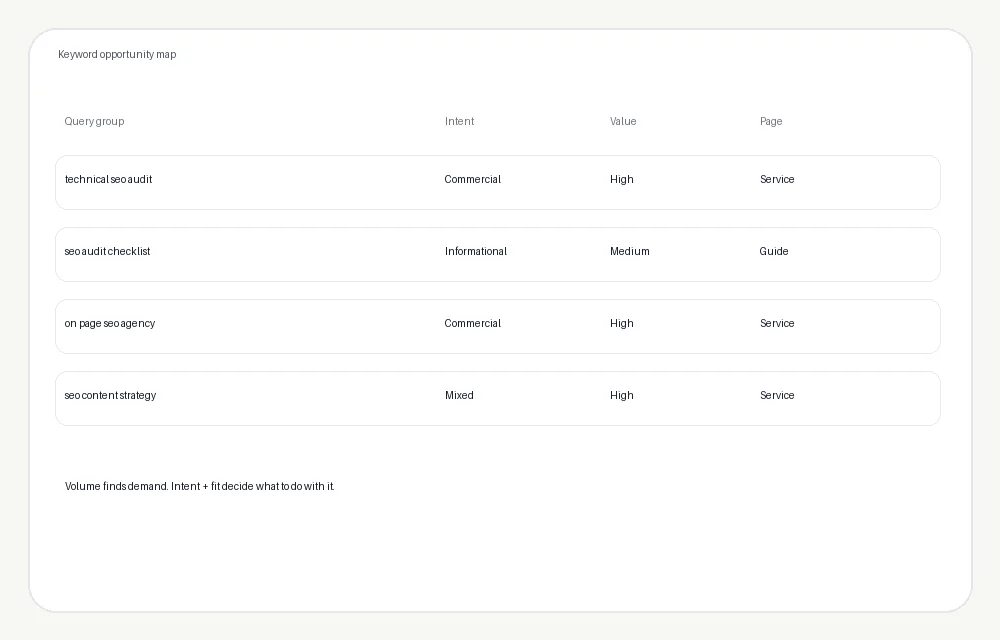
What do people search for directly?
We identify the obvious service, product and problem searches, including the terminology customers use rather than only internal business language.
Keyword research is not downloading 20,000 phrases and sorting by volume. The useful work is understanding what people mean, what kind of page can satisfy that search and whether winning it would matter to the business.
We research demand, intent, related queries, competitors and existing performance, then turn that information into a practical keyword and URL map.
We combine the language customers use with search data, existing Search Console performance, competitor visibility and SERP research where those sources are available.
The result is not just a list of phrases. We want to know which problems, services, products, comparisons and questions create useful search opportunities for the site.
We identify the obvious service, product and problem searches, including the terminology customers use rather than only internal business language.
Modifiers, questions, synonyms and related concepts can reveal the wider subject without requiring a new page for every wording variation.
Lower-volume queries can be valuable when they describe a precise problem, product attribute, comparison or buying requirement.
Queries already earning impressions can expose pages with relevance that may need better content, internal links, authority or clearer targeting.
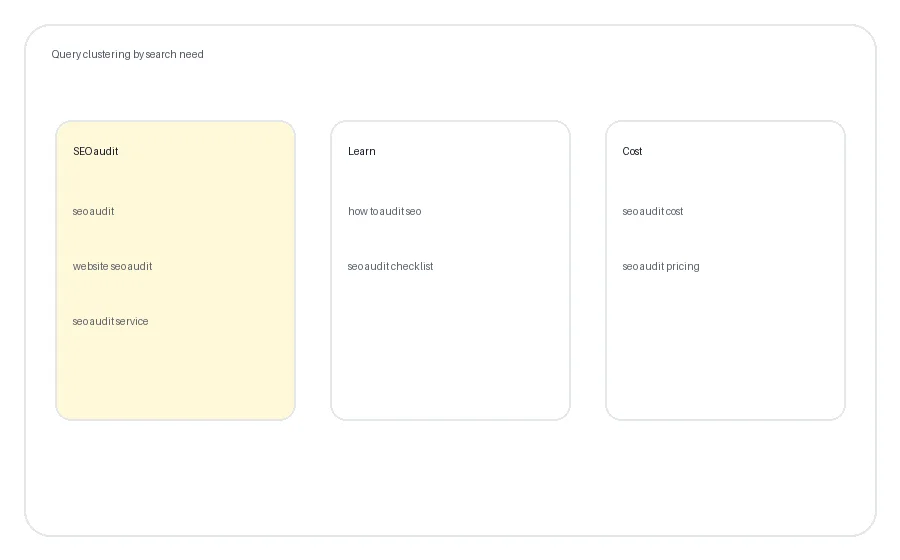
We group queries by the result and action the searcher appears to need. A service query, definition, comparison, troubleshooting question and price query may belong together — or may need different page types.
The SERP helps test that assumption. If substantially the same kinds of pages satisfy several phrases, one strong URL can often cover the cluster naturally.
We weigh demand against intent, relevance, competition, current authority, business value and the kind of page required. A smaller query close to a purchase or enquiry can matter more than a broad term that attracts people with no reason to become customers.
Keyword difficulty scores and CPC data can provide context, but they are third-party or advertising metrics. We use them as inputs, not as proof that a keyword will be easy, profitable or impossible.
Does the search connect to something the business actually offers or knows?
What action or answer does the searcher appear to want?
Does the current site have a realistic page, asset or authority path for the query?
Would relevant visibility contribute to enquiries, sales, assisted conversions or useful audience growth?
We look at the domains and pages repeatedly appearing for the searches that matter. Publishers, marketplaces, directories and specialist sites can all compete for organic visibility even when they do not sell the same thing.
Competitor gaps show topics and page types worth investigating. We still ask whether the opportunity belongs on your site instead of copying every keyword another domain ranks for.
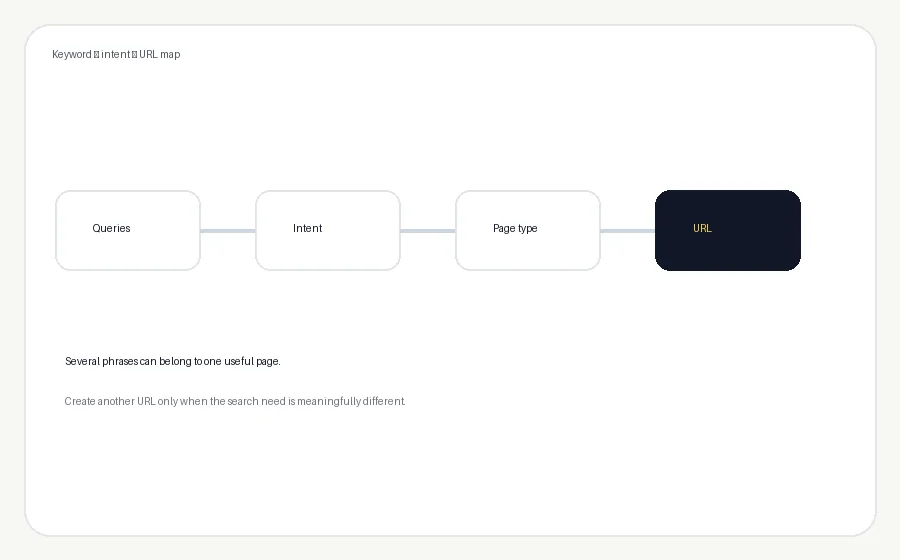
We map intent clusters to existing pages first. If a suitable page already exists, improving it can preserve history, links and current visibility. New pages are reserved for needs the current site cannot satisfy properly.
This also helps reduce cannibalisation and avoids building substantially similar pages that exist mainly to capture slight query variations.
Ecommerce research often needs categories, product attributes, brands, compatibility, use cases and filters. B2B work can involve low-volume specialist terminology with high commercial value. Local research needs genuine geographic intent rather than hundreds of cloned city pages.
We shape the research around how the business is bought and how the website can realistically be structured.
Generative search experiences can explore a topic through multiple related searches and subtopics. That makes understanding the underlying subject and intent even more useful.
We research related needs and concepts, but the site architecture still follows useful pages. We do not manufacture a URL for every conversational variation in the hope of manipulating AI or traditional search results.
Depending on scope, research can become a prioritised keyword set, intent clusters, page map, content opportunities, existing-page recommendations and competitor gaps. The important part is knowing what to build or improve next.
For the content built from that research, see Content SEO. For page-level optimisation, see On-Page SEO.
We gather core topics, related phrases, existing queries, competitor gaps and customer-language ideas.
We separate genuinely different needs from keyword variations that can live on one page.
We review what kinds of pages are being surfaced and whether the proposed page can realistically satisfy the need.
Clusters are assigned to existing or new URLs and prioritised by relevance, opportunity and business value.
It is the process of discovering and analysing the searches relevant to a website, understanding their intent and grouping them into useful opportunities that can be mapped to pages, content and business goals.
No. Volume estimates demand, but intent, relevance, competition, business value and the site’s ability to satisfy the search all matter.
Sometimes, but not automatically. Long-tail queries are more specific and often lower volume, yet competition and the quality required still vary widely.
No. Closely related phrases with the same underlying intent can often be served by one useful page. Creating substantially similar pages for slight variations can produce a poor site structure and, when done to rank for similar queries, can cross into doorway-style abuse.
It is a useful label for cases where several pages compete for substantially the same search need and make the site’s targeting unclear. We verify the actual query and page data before deciding whether to merge, differentiate or leave the pages alone.
Yes. Competitor visibility can reveal missing topics, formats and commercial opportunities, but we only keep ideas that make sense for your own audience and offer.
Yes, but the focus is broader than exact phrases. Understanding the underlying topic, related needs and language helps create useful pages for both traditional and generative search experiences.
No. Research improves targeting and prioritisation, but rankings depend on content quality, technical accessibility, competition, authority and search systems outside our control.
Send us the site, the services or products that matter and the markets you want to grow in.