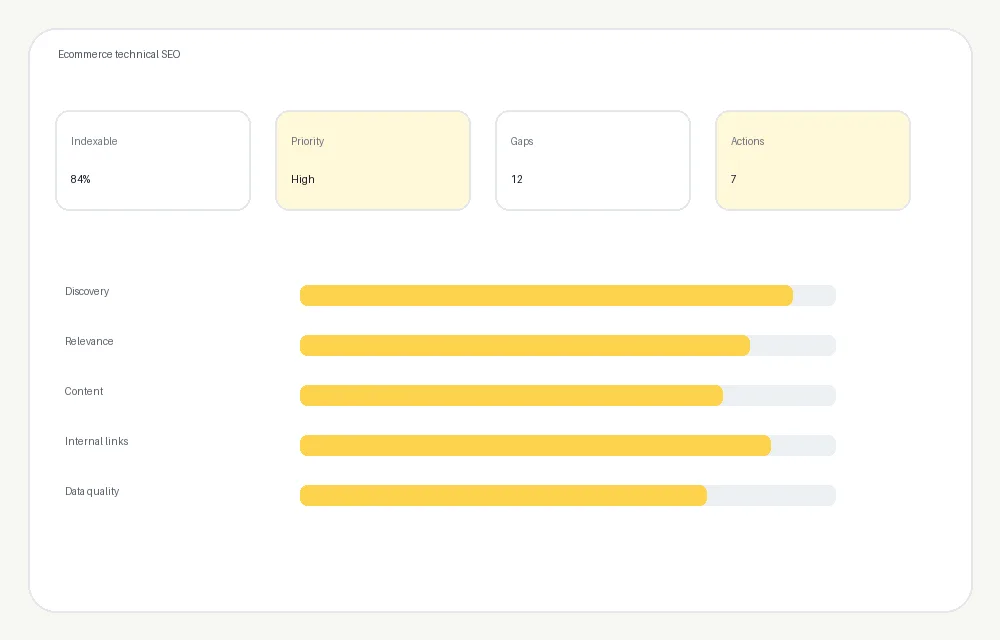
Indexable facets
Keep only combinations with genuine demand, useful inventory and enough distinct value to work as search landing pages.
Ecommerce sites can create thousands of URLs from categories, filters, sorting, variants, pagination and internal search. The technical job is deciding which URLs deserve discovery and indexation — then making the platform behave that way consistently.
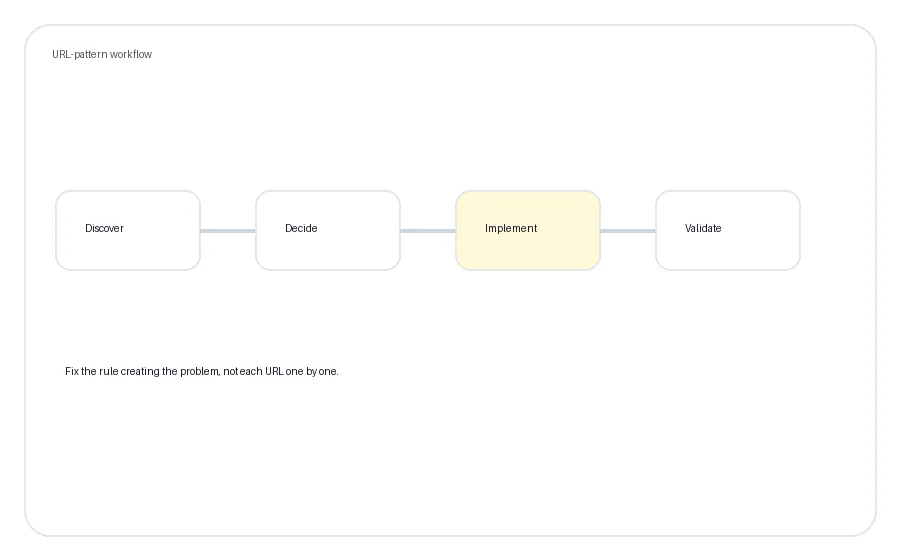
We audit URL patterns, crawl paths, canonicals, robots controls, pagination, sitemaps, structured data and product discovery at template level. Fix the rule once instead of reporting the same problem 20,000 times.
Colour, size, brand, price, compatibility and sorting combinations can multiply into a near-infinite URL space. We decide which combinations have real search value and which should remain navigation rather than landing pages.
The solution depends on the platform and whether filtered URLs need to rank. Robots controls, URL design, canonicalisation, internal linking and empty-result handling need to work together rather than contradict each other.
Keep only combinations with genuine demand, useful inventory and enough distinct value to work as search landing pages.
Reduce discovery of low-value combinations when those URLs do not need search visibility.
Avoid creating endless crawlable pages with no products or useful content.
Stable URL rules make crawling, canonicals, internal links and debugging easier to reason about.
We trace navigation from home to category, subcategory and product pages, looking for orphan products, excessive depth and JavaScript interactions that do not expose crawlable links.
Sitemaps and Merchant Center feeds can support discovery, but they do not replace a sensible internal architecture.
Some stores keep variants on one product URL; others expose distinct variant URLs. We make sure the chosen setup has consistent canonical signals, directly addressable states where required, accurate product information and structured data that matches what shoppers can see.
Variant SEO is not about indexing every possible parameter. It is about representing genuinely distinct purchasable options without creating duplicate chaos.
Load-more and infinite-scroll interfaces can be excellent UX, but product discovery cannot depend solely on user interaction. We make sure paginated sets expose crawlable URLs and links where needed.
We also review sort-order URLs, duplicate pagination patterns and category pages where deeper products become effectively invisible to crawling.
Product structured data can help search engines understand merchant information and can make eligible products available for richer search appearances. Merchant Center feeds can provide another direct product-data source.
We check that markup reflects visible product information, variant relationships are represented correctly where applicable and feed/site data is not fighting itself.
Categories, products, filters, parameters, variants, pagination and internal search.
Decide which page types and combinations deserve search visibility.
Align links, robots rules, canonicals, sitemaps and structured data.
Recrawl representative patterns and monitor indexation rather than checking one example URL.
See our main Ecommerce SEO service or broader Technical SEO service.
Only when a filtered combination creates a useful search landing page with genuine demand and inventory. Many filter combinations are better kept out of the index and sometimes out of crawl paths.
No. Canonicalisation is primarily a consolidation signal; it is not a crawl-control mechanism. Faceted crawling needs its own deliberate strategy.
Content that appears only after user interaction can be difficult to discover. Important products should have crawlable links or another search-friendly pagination path.
It depends on how variants are sold and represented. Distinct variant URLs can be supported, while single-page variant models are also possible. The URL, canonical and structured-data setup should be consistent.
It is not required for ordinary indexing, but valid product markup can improve Google’s understanding and eligibility for supported product-rich experiences.
Usually the useful fix is at configuration, template or routing level. Exact implementation depends on the ecommerce platform and development access.
Send us the site. We will map the patterns before recommending what to crawl, index, consolidate or block.
Audit my ecommerce SEO →