Commercial demand needs a deliberate structure.
Categories and subcategories should reflect meaningful product groupings and search intent, not just the internal organisation of the catalogue.
Magento gives ecommerce teams a great deal of control over products, categories, attributes, storefronts and catalogue behaviour. That flexibility is useful — but it also creates more places for crawling, indexation, duplication and architecture to go wrong.
We work through Magento’s actual catalogue structure, layered navigation, configurable products, URL behaviour, templates, search infrastructure and technical dependencies instead of treating the store like a generic CMS.
Magento can handle complex ecommerce requirements well. The SEO challenge is making sure that complexity produces a clear search architecture rather than thousands of URLs competing for crawl attention.
Categories and subcategories should reflect meaningful product groupings and search intent, not just the internal organisation of the catalogue.
Attribute combinations help shoppers refine large catalogues, but uncontrolled filter URLs can multiply the number of pages search engines discover without creating equivalent search value.
Parent products, child products, variants and attribute combinations need consistent URLs, internal links and product information so search signals are not divided unnecessarily.
Indexers, caching, search services, deployment, extensions and server configuration can all affect what the storefront outputs and how reliably important pages work.
Magento can support categories, subcategories, attributes, configurable products and very large inventories. That does not mean every possible product state should become a search landing page.
We review the relationships between navigation, category trees, product assignment, breadcrumbs, internal links and filtered catalogue states.
The purpose is to make commercially important sections easy to reach while preventing the catalogue from expanding into thousands of near-duplicate paths that search engines have little reason to index.
Category architecture matters here because it influences more than navigation. It determines where internal authority flows, which pages compete for broader product searches and how deeply important products sit inside the store.
Magento’s layered navigation can produce valuable browsing experiences and one of the largest technical SEO problems on the same store.
Colour, size, brand, price, material and other attributes can combine into a rapidly expanding URL space. We identify how those states are exposed through crawlable links.
Some filtered product groups may deserve dedicated landing pages. Most combinations exist because a shopper needs a temporary way to narrow a catalogue.
A canonical can indicate a preferred destination, but search engines still need to discover and process the unwanted URL before interpreting that signal.
Where attribute combinations have meaningful search demand, we prefer deliberate landing pages over relying on an accidental filter state to perform the job.
Magento SEO can involve the storefront, configuration, extensions, catalogue data and infrastructure at the same time. A page-level audit alone can miss the system producing the problem.
We compare indexable categories, products and parameter patterns with the pages the business genuinely wants search engines to surface.
Canonical tags, internal links, redirects and sitemap entries should not disagree about which version of a page matters.
Product removals, category changes and migrations can accumulate redirect chains or broken destinations that weaken navigation and waste crawl activity.
We use sitemap coverage as one signal for whether important categories and products are being exposed consistently.
Magento’s relationship between configurable products and simple variants creates decisions that simpler catalogues may never need.
Where variants share the same core search intent, the configurable product often provides the most useful destination for customers choosing between options.
A different SKU does not automatically represent different search demand. We look at whether individual variants genuinely need separate searchable destinations.
Size, colour, compatibility, material and specifications are useful when they clarify the product rather than simply reproduce internal catalogue fields.
Product, offer, price and availability information should be consistent with what customers actually see, particularly where variants affect those values.
A storefront can display the wrong output because of catalogue configuration, an extension, indexing, deployment or infrastructure. That is why diagnosis matters more than simply editing the visible HTML.
Magento relies heavily on indexed data. When indexing processes fail or fall behind, categories, prices and other catalogue behaviour can become inconsistent.
Extensions may alter metadata, layered navigation, structured data, redirects, canonical behaviour or frontend rendering. We check the rendered result rather than assuming core Magento is responsible.
Multiple stores, domains and languages need clear URL, localisation and canonical relationships so one storefront does not undermine another.
Magento catalogue search depends on an external search service in modern deployments. We consider its health when technical problems affect catalogue discovery or storefront behaviour.
Technical control creates the foundation. It does not replace the need for categories and products that satisfy the searches they target.
We compare category definitions with actual search behaviour and competing results rather than assuming the internal catalogue taxonomy mirrors customer language.
Specifications, compatibility, media, dimensions and supporting information matter when they answer questions buyers need resolved before purchasing.
Repeating supplier descriptions or template copy across a large catalogue can leave thousands of technically valid pages with little unique value.
Navigation, related categories, product relationships and editorial content can reinforce commercially important parts of the catalogue.
A slow category page may involve images, JavaScript, extensions, caching, template code, external services or server configuration. We look for the repeatable bottleneck rather than treating every slow page as an isolated frontend problem.
Theme JavaScript, sliders, product widgets, tracking and extensions can increase the work required before a page becomes useful.
Product galleries and category thumbnails need sensible sizing and delivery so merchandising quality does not become unnecessary loading cost.
Magento’s caching layers matter because slow backend generation can become a user problem long before anybody labels it an SEO problem.
Search services, database performance, deployment and server configuration may need investigation when frontend optimisation alone cannot explain the behaviour.
The same technical layers that affect a Magento migration, checkout or search service can also determine whether an SEO recommendation can be implemented reliably.
The project involved a 2.55 GB site archive and 212 MB database dump, with SQL collation incompatibilities, database privilege errors and filesystem permission problems affecting the restoration.
Elasticsearch 7.17.28 was also present in the target environment and validated as part of bringing the application stack back together.
A custom checkout method first failed to render. After that was corrected, payment submission returned an HTTP 400 because the live exchange-rate process failed further inside the payment flow.
The investigation followed the checkout renderer, Magento’s payment model and the fiat-to-crypto conversion path rather than stopping at the visible checkout error.
Shopify, WooCommerce and Magento can all rank well. Their technical constraints are simply different.
Configurable products, layered navigation, store views, extensions and large category structures create powerful ecommerce capabilities and more technical SEO dependencies.
Shopify manages more of the technical environment, reducing infrastructure responsibility while giving merchants less freedom over certain platform conventions.
WooCommerce inherits WordPress’s flexibility. Themes, plugins, hosting and taxonomies can produce very different SEO environments between two stores running the same ecommerce plugin.
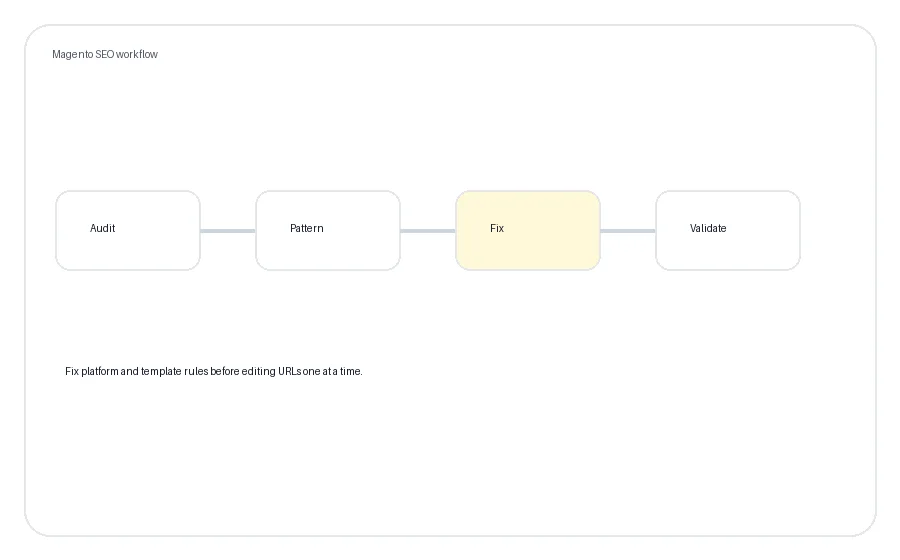
Large ecommerce sites reward fixes made at the correct layer. If one template or configuration rule causes the problem, manually correcting individual URLs is usually the wrong first move.
Crawl representative category, product, filter and store-view patterns and compare them with available Search Console and indexation evidence.
Determine whether the problem comes from catalogue configuration, templates, an extension, URL behaviour or another technical layer.
Work through configuration, templates, content, catalogue architecture and development dependencies in priority order.
Recrawl affected patterns, check the rendered output and monitor whether search engines process the intended changes.
Magento work regularly overlaps with broader ecommerce SEO. These areas cover the problems most likely to require a deeper investigation.
Crawlability, indexation, canonicals, redirects, structured data and technical catalogue behaviour.
Commercial search targeting, page usefulness, category structure and internal relationships.
Product targeting, information quality, variants, structured data and catalogue discovery.
Magento provides enough control to build a strong search architecture, particularly for large or complex ecommerce catalogues.
That flexibility also means configuration matters. Layered navigation, product relationships, extensions, store views and catalogue structure can create substantial SEO problems when they grow without a clear strategy.
Layered navigation lets shoppers combine attributes such as brand, colour, size or price. Those combinations can create a very large number of crawlable URL states.
Some combinations may have genuine search value. Many do not. The job is to distinguish useful landing pages from temporary navigation states rather than treating every filter the same way.
Not automatically.
A filtered page should have a clear reason to exist in search: meaningful demand, sufficiently distinct products and a stable destination that genuinely helps somebody searching for that combination.
It depends on whether the variants satisfy different search intent.
Where colours, sizes or other variants are simply choices inside one product family, the configurable product may be the most useful primary destination. Variants with genuinely independent demand can require a different approach.
Yes, depending on what the extension changes.
SEO, layered-navigation, search, schema, merchandising and frontend extensions can alter URLs, canonical tags, metadata, markup, crawlable links or rendering. We inspect the actual output instead of assuming Magento core is responsible.
Modern Magento deployments rely on an external search engine for catalogue search functionality. That makes the search service part of the application’s technical stack rather than an unrelated add-on.
When catalogue search or related storefront behaviour is failing, we consider that infrastructure as part of the diagnosis.
Yes. Magento’s store and store-view architecture can support different countries, languages and domains.
The SEO work is making sure URLs, localisation, canonicals, internal links and hreflang relationships remain consistent across those storefronts.
Not every initial audit does.
We can identify many crawling, indexation, architecture and content issues from the storefront and search data. Implementation may require Magento admin, theme or server access depending on where the underlying problem sits.
It depends on the problem, catalogue size and competition.
Correcting a technical indexation issue has a different timeline from restructuring categories or building visibility for competitive commercial searches. Search engines also need time to recrawl and process substantial catalogue changes.
For ongoing SEO, several months usually provide a more useful evaluation window than a few weeks. That is a planning horizon, not a ranking guarantee.
Send us the store, the markets you’re competing in and what you want organic search to contribute. We’ll look at the catalogue, technical structure and available search evidence before deciding what deserves attention first.