
Too many URLs. Not enough useful pages.
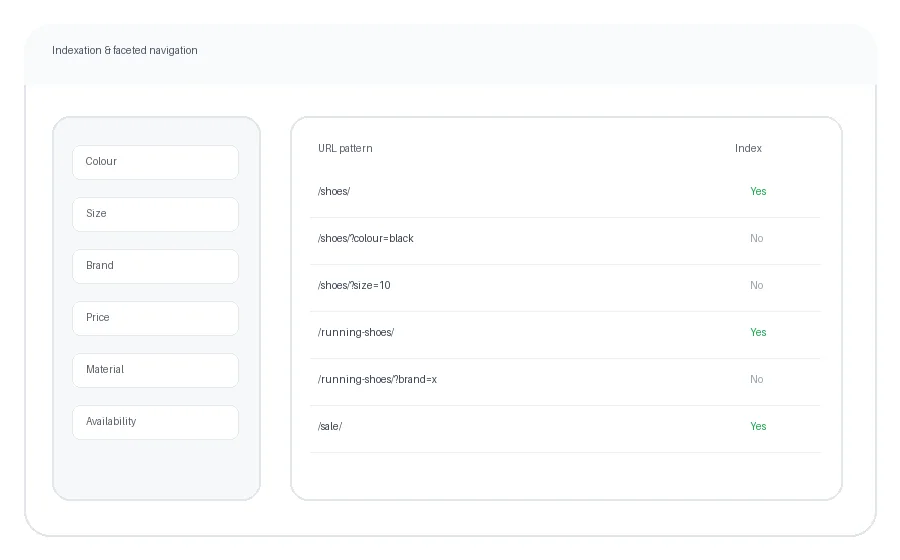
Filters, sort options, internal search and tracking parameters can create large numbers of low-value URLs. We work out what should be indexable and what should not.
Product pages, categories, filters, duplicate URLs, out-of-stock products and thousands of internal links can turn a normal SEO problem into a catalogue-sized one.
Our ecommerce SEO work focuses on making the store easier for search engines to understand and easier for customers to find when they are ready to buy.
A filter creates a new URL. A product disappears. Two categories target the same search. A useful page sits six clicks away from the homepage. One technical problem can quietly scale across the whole store.
That is why ecommerce SEO needs more than optimising a few product descriptions.
Filters, sort options, internal search and tracking parameters can create large numbers of low-value URLs. We work out what should be indexable and what should not.
Commercial pages should be easy to discover through the site structure and internal linking, not hidden several layers deep behind navigation that only makes sense to the store owner.
Products, categories, tags and filtered pages can send mixed signals. We map the search intent to the right page and reduce unnecessary overlap.
Temporary stock changes, discontinued products and replacement models need different handling. We look at what should stay live, redirect, remain indexable or be consolidated.
Large stores can waste crawl activity on filtered, duplicated and low-value URLs while the pages that actually drive revenue receive less attention.
We review canonicals, robots directives, pagination, sitemaps, internal search, filters, URL parameters, redirects and the way product states are handled.
Category pages are often where ecommerce SEO becomes commercially useful. They can target searches where the user wants a choice of products rather than a single item or a long informational article.
We work on category structure, search intent, headings, supporting copy, internal links, filters and the products being surfaced on the page.

Manufacturer descriptions copied across dozens of retailers do not give a search engine much reason to prefer one store over another.
We look at titles, product naming, specifications, useful supporting information, product schema, internal linking and how variants are handled. The goal is not to turn every product page into an essay. It is to make the page clearer and more useful.
We do not treat every ecommerce system as if the URLs, templates and technical limits work the same way.
Large catalogues, layered navigation, configurable products, category structure and technical complexity make Magento stores especially sensitive to indexation and architecture problems.
We work within Shopify’s URL and template structure while improving collections, products, internal linking, duplicate handling and search visibility.
WordPress gives stores flexibility, but plugins, themes, taxonomy and performance can create their own SEO problems. We work across both the store and the WordPress layer.
We look at templates, indexation, categories, products, filters, current traffic and how search engines are interacting with the store.
A template-level fix affecting thousands of URLs usually deserves attention before polishing one product page.
We can work alongside your development team or handle the SEO implementation that sits within our scope.
We care about visibility and traffic, but we also keep attention on categories, products and queries that can contribute to actual sales.
Faceted navigation, crawling, indexation, variants, pagination and product discovery.
Commercial category demand, content, internal linking, filters and inventory handling.
Product content, variants, structured data, images, feeds and product lifecycle.
Technical fixes, content, internal links and authority all affect the store. When needed, ecommerce work connects with our SEO services and link building services.
If a store already has enough authority, we will not prescribe link building just to fill a package. If the real issue is technical, that is where the work should start.
Collections, filters, variants, Markets, themes and apps.
WordPress themes/plugins, taxonomies, variable products, permalinks and performance.
Large catalogs, URL rewrites, layered navigation, multi-store setups and infrastructure.
The fundamentals are the same, but ecommerce sites usually have more URLs, more templates and more duplicate or near-duplicate page types. Filters, product variants, categories, stock changes and internal linking make the technical side more complex.
Yes. The larger the catalogue, the more important it becomes to work at template and architecture level instead of treating every URL as a separate manual task.
No. The page needs enough useful and distinctive information for the product and search intent. Forcing long copy onto every product can make the store worse for users without solving the underlying SEO problem.
Yes. We can provide the SEO requirements, explain the reason behind them and work alongside your existing development team during implementation.
No. We can improve technical quality, page targeting, internal linking, content and authority, but we do not control search engines, competitors or customer demand.
Our work can cover stores on platforms including Magento, Shopify and WooCommerce. The exact implementation depends on how the store has been built and customised.
Send the store, the market you are targeting and what has been happening with organic search. We can look at the structure before deciding what work makes sense.